Product Teams
A Simple Framework for Building Teams That Actually Work

Antonio Scapellato
Jan 15, 2026 • 6 min read
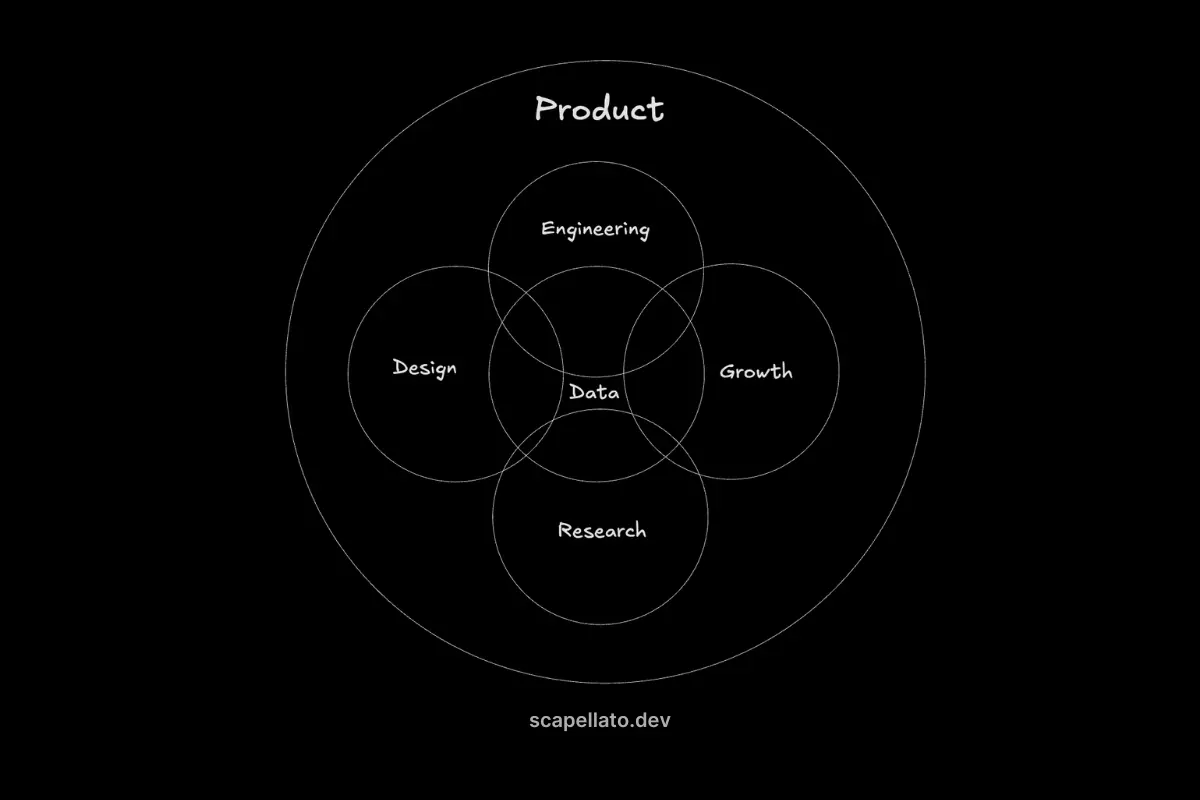
My idea of product teams is simple.
You have a big circle that is Product.
Inside that circle, you have another circle: Data.
And in four angles, four circles that intersect with Data: Engineering, Growth, Design, and Research.
Each team has a specific function, and they're all connected through data.
The Product Circle
Product is the container. It's the big picture—the vision, the strategy, the "why" behind everything you're building. This isn't just a department or a role. It's the entire system that makes your product successful.
When Product is done right, it creates clarity. Everyone knows what they're building, why they're building it, and how success is measured. Without this big circle, teams drift. Priorities conflict. Work becomes disconnected.
The Data Circle
Data sits at the center of everything. It's not just analytics or metrics—it's the truth that connects all teams. Data tells you what's working and what's not. It shows you where users struggle and where they succeed. It reveals opportunities and exposes assumptions.
Every team needs data. Engineering needs it to understand performance and bugs. Growth needs it to see what channels work. Design needs it to validate user experience. Research needs it to identify patterns and insights.
But here's the thing: data alone is useless. It only becomes valuable when teams act on it. That's where the four specialized teams come in.
The Four Teams
Engineering
Engineering builds. They take ideas and turn them into reality. But great engineering teams don't just code—they use data to make decisions. Which features are actually being used? Where are the performance bottlenecks? What's breaking in production?
Data helps engineering prioritize. It shows them what matters to users and what doesn't. It guides technical decisions and helps them build the right things, not just more things.
Growth
Growth scales. They find channels, optimize funnels, and drive adoption. But growth without data is just guessing. Which channels are actually profitable? Where are users dropping off? What messaging converts?
Data is growth's compass. It shows them where to invest time and money. It reveals what's working and what's wasting resources. Without data, growth teams are just throwing darts in the dark.
Design
Design creates experiences. They make products beautiful, intuitive, and delightful. But design without data is just opinion. Are users actually using this feature? Is this flow confusing? Does this design solve the problem?
Data validates design decisions. It shows designers what users actually do, not what they say they do. It reveals friction points and opportunities for improvement. Great designers use data to create experiences that work, not just look good.
Research
Research discovers. They understand users, markets, and opportunities. But research without data is incomplete. What patterns exist in user behavior? What trends are emerging? What assumptions need testing?
Data enriches research. It provides quantitative backing for qualitative insights. It reveals patterns that interviews and surveys might miss. Research teams use data to build a complete picture of users and markets.
The Connection
Here's what makes this framework powerful: all teams are connected through data.
Engineering builds features, and data shows if they're working. Growth experiments with channels, and data shows what converts. Design creates experiences, and data shows if users can use them. Research discovers insights, and data validates them.
But it's not one-way. Data flows in both directions. Teams generate data through their work, and they consume data to make decisions. This creates a feedback loop that makes the entire product better.
Scaling and Context
This framework scales. Whether you're a five-person startup or a five-thousand-person company, the structure works. The circles don't change—only their size and emphasis.
Here's the key insight: not all teams are created equal, and they shouldn't be. Based on your company type, product stage, and business model, one team will naturally be bigger and more important than the others. That's not a bug—it's a feature.
B2B SaaS
In B2B SaaS, after the initial product-market fit period, Growth becomes the dominant team. You've built something that works. Now you need to scale. Growth teams drive customer acquisition, optimize conversion funnels, and expand within accounts. Engineering still matters, but growth is what moves the needle on revenue.
Early stage? Engineering and Research are critical—you're still figuring out what to build. But once you have traction, growth takes the lead.
B2C Products
In consumer products, Design and Growth share the spotlight. Design creates the experience that makes users fall in love with your product. Growth gets it in front of them. Both are essential, and they work hand-in-hand.
Engineering is still important, but it's often more about reliability and performance than new features. Research helps understand user behavior, but design and growth drive the business.
Hardware and Research-Intensive Fields
In hardware, biotech, or other research-intensive fields, Engineering and Research dominate. You can't fake hardware. You can't skip research. These teams are building the foundation that everything else sits on.
Growth and Design matter, but they're supporting roles. You can't market a product that doesn't work. You can't design something that hasn't been researched. Engineering and Research create the moat.
The Stage Matters
Early stage? Engineering and Research are probably your biggest teams. You're building and learning.
Growth stage? Growth becomes critical. You've proven the product works—now you need to scale.
Mature product? It depends on your business model, but often Growth or Engineering (for platform/scale) takes the lead.
The framework adapts. The circles stay the same, but their relative importance shifts based on what your product needs most right now.
Why This Works
Most product teams are siloed. Engineering builds. Growth markets. Design designs. Research researches. They work in parallel, occasionally colliding, but rarely truly collaborating.
This framework changes that. By centering everything on data, you create a shared language. Everyone speaks the same truth. Decisions are based on evidence, not opinions. Teams can see how their work connects to the bigger picture.
It's simple, but it works. Product contains everything. Data connects everything. And four specialized teams use data to make the product better.
That's it. That's the framework.
No complex org charts. No confusing hierarchies. Just a simple structure that helps teams build products that actually work.